
Monday, 2 March 2026
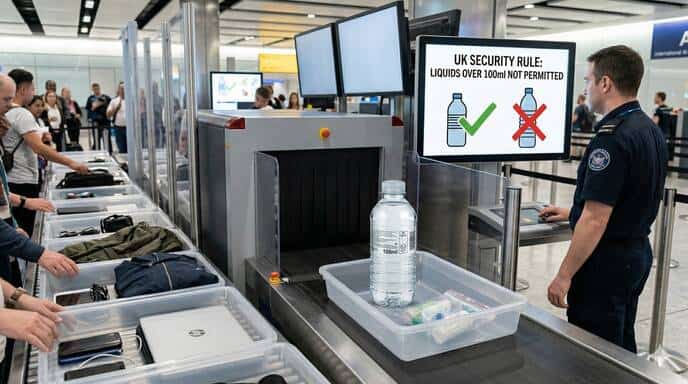
After nearly two decades of decanting toiletries into miniature bottles and wrestling with flimsy plastic bags, the UK’s air travel experience is undergoing its most significant security overhaul since 2006. As of March 2026, the long-predicted “end of the 100ml rule” has shifted from a pilot project to a reality at many of the UK’s largest aviation hubs.
However, the rollout remains a patchwork. For the 2026 holidaymaker, knowing which rules apply at which terminal is the difference between a seamless stroll to the departure lounge and a frustrating delay at the X-ray machine.
The New Standard: 2 Litres and “Laptops In”
What has changed: At airports fully equipped with Next-Generation Security Checkpoints (NGSC), the rulebook has been rewritten. Thanks to high-definition Computed Tomography (CT) scanners—which create detailed 3D images of bag contents—security staff can now identify potential threats without requiring passengers to unpack.
The Three Major Upgrades:
- Volume Boost: The restrictive 100ml limit is replaced by a generous 2-litre allowance per container.
- No More “Liquid Bags”: You are no longer required to place your liquids in a transparent, resealable plastic bag. They can remain anywhere in your hand luggage.
- Electronics Stay Packed: Laptops, tablets, and large cameras no longer need to be placed in a separate tray.
Why it matters: Heathrow alone estimates this will save nearly 16 million single-use plastic bags annually. More importantly for the traveller, it is expected to cut average security processing times by up to 30%, significantly reducing the “bottleneck” effect during peak morning periods.
The 2026 “Liquid Map”: Where Can You Carry More?
As of March 2026, the UK’s airports are split into two categories: those that have fully “cut over” to the new rules and those still operating under the old 100ml regime during their final transition phase.
| Fully Scrapped 100ml Rule (2L Allowed) | Still Enforcing 100ml (Old Rules Apply) |
| London Heathrow (All Terminals) | Manchester (T1 & T3) |
| London Gatwick (North & South) | London Stansted |
| Birmingham | London Luton |
| Edinburgh | East Midlands |
| Bristol | Newcastle |
| Teesside & London City | Leeds Bradford |
The Manchester & Stansted Exception: While Manchester’s new Terminal 2 is now largely equipped with the new technology, the airport (along with Stansted and Luton) is still advising passengers to stick to 100ml containers for the time being to ensure consistency across their older terminals. If you are flying from these hubs, assume the 100ml rule still applies unless a security officer specifically directs you otherwise.
The “Double-Wall” Trap: A New Security Hurdle
While you can now carry a full-sized bottle of shampoo, there is a new technicality that is catching out savvy travellers: the metal flask rule.
The Problem: The new CT scanners, while powerful, struggle to “see through” double-walled or vacuum-insulated metal containers (such as Chilly’s bottles or thermal coffee mugs).
The Rule: Even at “upgraded” airports like Heathrow or Gatwick, metal water bottles must be empty before you pass through security. Once you are airside, you can refill them at the water stations as usual. If you leave liquid inside a metal flask, it will almost certainly trigger a manual bag search, negating any time saved by the new scanners.
Context: The “Return Leg” Risk
The most critical piece of advice for UK travellers in 2026 is to look beyond the departure gate. While the UK is a global leader in adopting this technology, much of the rest of the world—including many popular European and US destinations—is moving at a slower pace.
The Scenario: You fly out of Heathrow with a 500ml bottle of high-end sun cream in your hand luggage. You have a fantastic week in Spain or Greece. On your return journey, you arrive at the local airport only to find they still enforce the international 100ml limit. Result: Your expensive sun cream is confiscated at the gate.
Pro-Tip: If you are travelling hand luggage only, check the security rules of your return airport before buying large liquids in the UK. Until the 2-litre rule becomes a global standard (likely not before 2028), the “100ml rule” effectively still lives on for the return half of your holiday.
Analysis: Why Has It Taken So Long?
The UK government originally mandated a 2022 deadline for this technology, which was later pushed to 2024, and finally to June 2025 for most major hubs. The delays were largely due to two factors:
- Structural Integrity: The new CT scanners are significantly heavier than the old X-ray machines. Several airports, including Heathrow and Gatwick, had to physically reinforce terminal floors with steel beams to support the weight.
- Supply Chain: With every major airport in the world wanting the same technology at the same time, a global shortage of high-spec scanners caused a three-year backlog in deliveries.