
Monday, 2nd March 2026
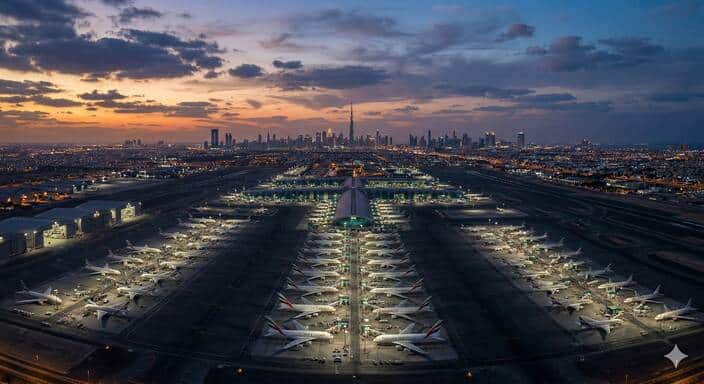
The global aviation landscape has been plunged into chaos this week following the sudden and comprehensive closure of airspace across the Middle East. For UK travellers, the impact is profound: three of the world’s most critical transit hubs—Dubai (DXB), Doha (DOH), and Abu Dhabi (AUH)—have effectively ceased normal operations, severing the primary “bridge” between the British Isles and the Eastern Hemisphere.
As of Monday morning, the Foreign, Commonwealth & Development Office (FCDO) estimates that approximately 76,000 British nationals are currently in the affected region, with the vast majority situated in the United Arab Emirates. With military activity escalating, the “dark” airspace has forced a total rethink of global flight paths, leaving passengers, airlines, and regulators scrambling to manage the fallout.
The Hubs Fall Silent: Dubai and Doha Grounded
What happened: Following retaliatory missile strikes over the weekend, civil aviation authorities in the UAE, Qatar, Bahrain, and Israel enacted emergency closures of their respective airspaces. This was not a partial restriction but a total suspension of civilian overflights to ensure the safety of commercial aircraft.
Who is involved: The “Big Three” Gulf carriers—Emirates, Qatar Airways, and Etihad—have been forced to cancel hundreds of flights. In the UK, British Airways and Virgin Atlantic have suspended all services to Tel Aviv, Amman, and Riyadh. Furthermore, long-haul flights to destinations such as Australia, Singapore, and India are being diverted on circuitous routes over Central Asia or Africa.
When it occurred: The primary closures began late on Saturday, 28th February, and were extended through Sunday. As of 9:00 AM today, 2nd March, most hubs remain under severe restriction, with only limited “humanitarian corridors” being discussed.
Why It Matters to UK Passengers
For the average British holidaymaker, the Middle East is no longer just a destination; it is the vital artery of long-haul travel.
- Stranded in Transit: Thousands of Brits are currently in “limbo” at terminal buildings in Dubai and Doha. Because these are transit hubs, many passengers do not have visas to exit the airport and enter the country, creating a secondary humanitarian challenge for airport authorities.
- The “Five-Hour” Penalty: Flights that are still operating to Asia and Oceania are now taking significantly longer. By avoiding the Middle Eastern corridor, a standard flight from London to Perth is now roughly 4–5 hours longer, necessitating extra fuel stops and causing widespread crew-hours violations.
- Regional Volatility: The FCDO has upgraded travel advice for the entire region. British nationals in the Gulf are currently advised to “register their presence” via the official government portal and stay indoors until further notice.
Analysis: A Fragile Recovery Interrupted
This crisis comes at a time when UK aviation was celebrating a full recovery to pre-pandemic levels. The closure of these hubs doesn’t just affect those going to Dubai; it creates a global bottleneck. When Dubai International closes, the ripple effect reaches London Heathrow within hours.
Airlines are already warning that even if airspace reopens tomorrow, the “repositioning” of aircraft and crews will take at least seven to ten days to resolve. For those with bookings later this week, the advice is clear: do not travel to the airport unless your airline has specifically confirmed your flight is operating via a rerouted path.