
Sunday, 8 March 2026
It was heralded as the definitive end to one of air travel’s most universally despised rituals: the frantic deciphering of liquid limits and the squeezing of miniature toiletries into a flimsy, transparent plastic bag. The United Kingdom’s transition to Next-Generation Security Checkpoints (NGSC) utilising advanced 3D Computed Tomography (CT) scanners promised to allow passengers to leave laptops in their hand luggage and carry up to two litres of liquid through security.
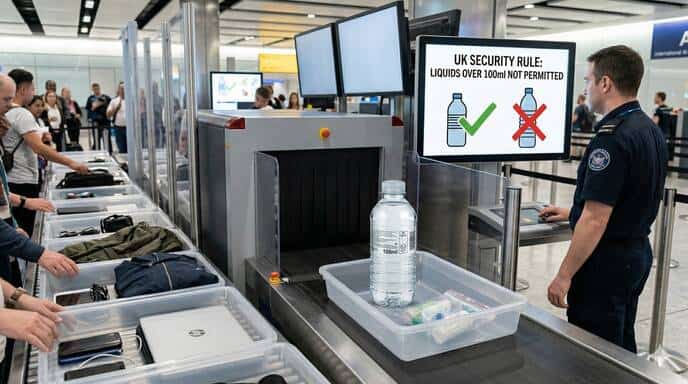
However, as we progress into the spring of 2026, the reality on the ground is a deeply fragmented, highly confusing regulatory landscape. Successive government deadline extensions, supply chain bottlenecks, and severe terminal infrastructure limitations have resulted in a “liquid lottery.” For the UK holidaymaker, knowing precisely which rules apply at which airport has never been more critical to avoiding costly confiscations and massive security delays.
Next-Generation Checkpoints: The Stumbling Block
What happened: The Department for Transport (DfT) originally mandated that all major UK airports must fully implement new CT scanning technology, thereby abolishing the 100ml liquid rule. Following several deadline extensions stretching from 2024 into 2025, early 2026 reveals a completely fractured implementation. Some airports have successfully “cut over” to the new rules, whilst others remain stubbornly reliant on the outdated 2D X-ray systems, forcing a continuation of the 100ml restriction.
Who is involved: The UK Civil Aviation Authority (CAA), the Department for Transport, and all major UK commercial airports, alongside millions of bewildered domestic and international passengers.
When it is occurring: This acute confusion is occurring right now, creating significant friction at security checkpoints just as the volume of Easter holiday traffic begins to surge.
Why it matters to UK passengers: If a traveller assumes the new two-litre rule applies nationwide, they risk arriving at an un-upgraded terminal with full-sized sunscreens, expensive perfumes, and large bottles of water. These items will be ruthlessly confiscated by security personnel, leading to significant financial loss and severe congestion in the security lanes as bags are pulled for manual, secondary screening.
The 2026 “Cut-Over” Map: Which UK Airports Have Relaxed the Rules?
Local Relevance & Analysis: The primary issue for the British flyer is that the rules differ not just from city to city, but occasionally from terminal to terminal within the same airport. The heavy weight of the new CT machines required some airports to literally reinforce their concrete floors with steel beams, causing massive delays in older buildings.
The Current Landscape (As of March 2026):
- Fully Upgraded (2-Litre Limit Applies): Airports such as London City, Teesside, Aberdeen, Birmingham, and Bristol have entirely completed their upgrades. Passengers here can carry up to two litres of liquids in their hand luggage, and large electronics can remain securely packed inside their bags.
- The Major Hubs: London Heathrow and London Gatwick have made monumental strides, with the vast majority of their security lanes now operating the new CT scanners. However, during peak flow periods, passengers may still be diverted to older, overflow lanes where the 100ml rule abruptly applies.
- The Outliers: Major regional powerhouses like London Stansted, East Midlands, and Manchester (specifically Terminals 1 and 3) have struggled to meet the deadlines across their entire estates. At these locations, passengers are strongly advised to pack assuming the strict 100ml rule is still in total, unyielding effect.
Expert Advice: Do not rely on hearsay or outdated news reports. You must check the official website of your specific departure airport and your specific terminal less than 24 hours before you travel to confirm their exact liquid policy.
The Confiscation Trap: The Peril of the Return Journey
Context & Analysis: Even if your local UK airport has successfully abolished the 100ml limit, a far more insidious trap awaits the British holidaymaker on the return leg of their journey.
The United Kingdom is a global frontrunner in the adoption of this CT technology. The vast majority of the European Union, the United States, and popular North African holiday destinations are years behind in their procurement of these expensive scanners.
Consider a common 2026 scenario: A passenger flies out of London City Airport with a 500ml bottle of luxury sun lotion in their cabin bag. They enjoy a week in the Greek islands. On their return journey, they arrive at the local Greek airport, which is still exclusively utilising legacy 2D X-ray machines. Because international aviation security standards dictate that the departure airport’s rules take precedence, the Greek security officers will confiscate the 500ml sun lotion immediately.
For the British traveller flying on a “hand-luggage only” ticket with airlines like easyJet or Ryanair, the rule of thumb remains brutally simple: until the entire world upgrades, you must pack your liquids based on the capabilities of your return airport, not just your UK departure hub.
The Metal Bottle Anomaly: Why Your Vacuum Flask is Still an Issue
Amidst the sweeping technological changes, a highly specific technical anomaly is causing massive bottlenecks at even the most advanced, fully upgraded UK airports: the double-walled metal water bottle.
The Issue: High-end, vacuum-insulated metal flasks (such as those manufactured by Chilly’s, Yeti, or Ocean Bottle) are constructed with a dense metallic double wall designed to retain temperature. While the new CT scanners provide a brilliant 3D image of a bag’s contents, the X-rays simply cannot penetrate the dense metal casing of these specific flasks to determine what liquid is inside.
The Result: If you leave even a small amount of liquid inside a double-walled metal bottle, the CT scanner will flag it as an “opaque threat.” Your bag will be automatically diverted off the main belt, requiring a time-consuming manual search and a physical swab test by a security officer.
Passenger Guidance: Even if you are flying from an airport that allows two litres of liquid, you must completely empty any double-walled metal flasks before placing your bag in the security tray. You can freely carry an empty flask through the scanners and refill it at a water fountain in the departure lounge, ensuring a rapid, seamless start to your holiday.