
Friday, 6 March 2026
The United Kingdom awoke this morning to the largest sudden disruption of its citizens’ freedom of movement since the unprecedented border closures of the COVID-19 pandemic. A sudden and severe escalation of military conflict across the Middle East has forced the complete closure of commercial airspace over Iran, Iraq, Kuwait, Qatar, Bahrain, Syria, and the United Arab Emirates. With the skies above the region now deemed too hazardous for civilian aircraft, a vast “black hole” has appeared on global aviation maps, severing the primary transit arteries between Europe, Asia, and Australasia.
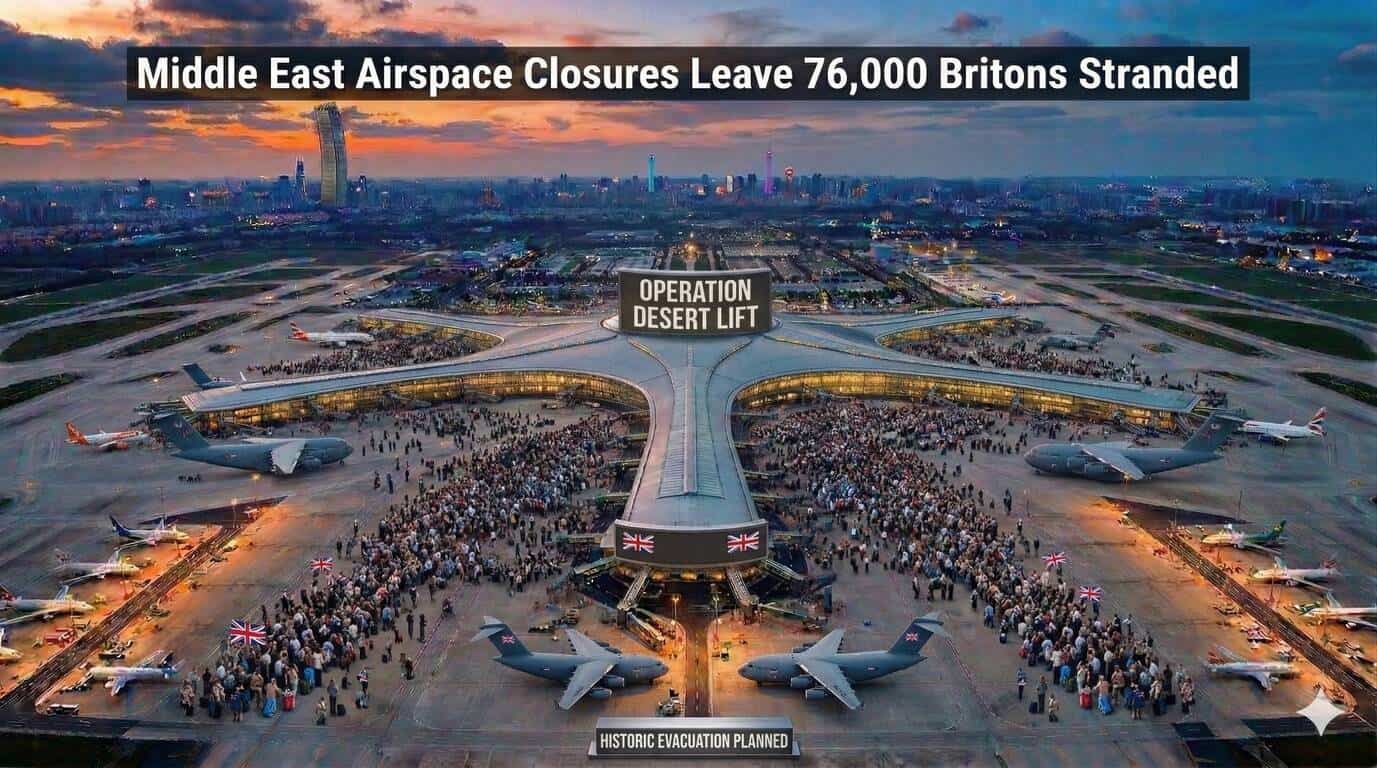
With Dubai International, Abu Dhabi, and Doha Hamad International three of the world’s busiest and most vital transit hubs suspending all commercial operations, more than 3,400 flights have been cancelled globally. For the UK, the human cost is staggering. The Foreign, Commonwealth & Development Office (FCDO) estimates that 76,000 British nationals are currently registered in the affected states, with roughly two-thirds of them being holidaymakers stranded in the UAE. As diplomatic efforts falter, the UK government is now laying the groundwork for what defence officials are privately describing as a mass evacuation on the scale of Afghanistan, but conducted entirely by air and sea.
The Blackout of the Gulf: What Happened?
The crisis was triggered by retaliatory missile strikes deep within the region earlier this week, prompting local civil aviation authorities to enact emergency, sweeping closures of their respective airspaces. Unlike previous localised conflicts where airlines could utilise narrow “safe corridors” over neighbouring countries, the sheer geographical spread of this incident has rendered the entire Persian Gulf impassable.
Major UK and international carriers have been forced into taking drastic measures. British Airways and Virgin Atlantic have completely grounded services to Tel Aviv, Bahrain, and Amman. Crucially, the Middle Eastern “Big Three” Emirates, Qatar Airways, and Etihad have suspended the vast majority of their global networks. Because these airlines operate on a “hub and spoke” model, the closure of their home airports means their aircraft cannot function. Consequently, hundreds of thousands of passengers are currently stranded mid-journey, languishing in terminal buildings or being hastily accommodated in overflow hotels in cities far from their intended destinations.
The Government Response: Planning for Mass Evacuation
With the situation showing no signs of de-escalation, ministers in Whitehall have ordered urgent contingency planning for an assisted departure programme. The FCDO has upgraded its travel advice to the highest possible alert level, urging British nationals in the affected Gulf states to “shelter in place,” stay away from military installations, and immediately register their whereabouts via the government’s online crisis portal.
Evacuation flights, should they be formally triggered this weekend, will face immense logistical hurdles. Experts suggest that military transport and chartered commercial airliners would likely operate from the fringes of the conflict zone such as Muscat in Oman or possibly Saudi Arabia once humanitarian air corridors can be negotiated. Employers with expatriate staff in free-trade zones across the region are currently activating corporate risk-management protocols, while the FCDO prepares for what could be the most complex peacetime repatriation in British history.
Airline Turmoil: Rerouting and the “Five-Hour Penalty”
For passengers booked on flights that bypass the Middle East but are headed further east to destinations such as India, Southeast Asia, and Australia the journey is far from straightforward. UK airlines are desperately trying to maintain vital global connectivity by re-routing their wide-body aircraft over Turkey, the Caucasus, and Central Asia, or southwards over the African continent.
However, this diversion comes with a severe penalty. Bypassing the Gulf adds up to five hours of flight time to a standard journey from London Heathrow to Singapore or Perth. Aviation analyst John Strickland notes that forcing heavily laden wide-body aircraft through these extended routes requires additional technical stops for refuelling, introduces massive crewing complications due to strict legal limits on pilot duty hours, and exponentially increases fuel burn. Travel industry analysts estimate that these airspace closures could be costing UK airlines more than £35 million a day in lost revenue and operational inefficiencies.
Knowing Your Rights: The “Extraordinary Circumstances” Loophole
As frustration boils over at check-in desks across London Heathrow, London Gatwick, and Manchester Airport, it is vital that passengers understand their statutory rights. Under UK261 legislation, airlines are heavily regulated in how they must treat disrupted passengers.
However, there is a critical caveat. Because this disruption is directly caused by military conflict and government-mandated airspace closures, it is legally classified as “extraordinary circumstances.” This classification means that airlines are completely exempt from paying out the standard fixed-sum cash compensation (which usually ranges from £220 to £520 per passenger) for delayed or cancelled flights.
Despite this, airlines cannot simply abandon their passengers. They remain legally bound by a strict and unwavering Duty of Care. Regardless of the cause of the disruption, your airline is legally obligated to provide:
- A Choice of Resolution: You must be offered a full refund of your ticket or re-routing to your final destination at the earliest opportunity (even if that involves booking you onto a rival carrier).
- Essential Provisions: While you are waiting at the airport, the airline must provide vouchers for food and drink proportionate to the waiting time.
- Accommodation: If your flight is delayed overnight, or your rerouted flight departs the next day, the airline must provide hotel accommodation and transport between the airport and the hotel.
If the airline’s ground staff are overwhelmed and cannot provide a hotel voucher, the UK Civil Aviation Authority (CAA) advises passengers to book their own “reasonably priced” accommodation, keep every single itemised receipt, and claim the expenses back from the airline at a later date.
Local Relevance: The Impact on UK Summer Travel
The ramifications of this week’s events will be felt by UK travellers long after the airspace reopens. The Gulf carriers are responsible for moving a massive percentage of British tourists. When their fleets are grounded, the global supply of airline seats shrinks dramatically, leading to an immediate and sharp increase in airfares on alternative routes. Furthermore, corporate travel managers are advising business travellers to avoid transits through the Middle East for at least the next quarter, fundamentally reshaping corporate travel patterns.
For the British holidaymaker, this underscores the immense value of booking ATOL-protected package holidays. Travellers who booked through major operators like TUI or Jet2 are currently being offered free re-bookings to safe alternative destinations, such as the Canary Islands or the Caribbean. Independent travellers, however, face a much tougher battle to reclaim their funds from individual hotels and airlines.